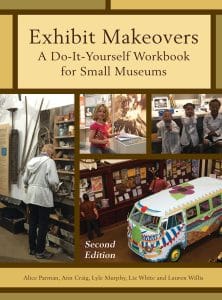
One of the things we sometimes hear at the end of a training session is, “that was great, but we are too small to implement any of the suggestions”. If you’ve ever said that to yourself or had that discussion with colleagues in your museum, this book is for you. This substantially revised second edition was published in 2017, and was designed specifically for small museums and the staff and volunteers who are responsible for developing exhibits. The authors do a wonderful job of giving reassurance to readers. They cheer you on and remind you that you can do an exhibit makeover. You just need a plan, some creativity, and a willingness to start somewhere.
 I love how the book builds on itself. It is structured around three increasingly ambitious projects: transforming a single display case, overhauling a gallery space, and eventually tackling a whole-museum makeover. This progression is one of its most useful lessons. You don’t have to wait for the mythical day when your museum receives a major grant and can work with a professional designer. Start with one case. Learn from it. Build your skills. Then tackle something bigger. The authors walk readers through planning, interpretation, design, fabrication, installation, evaluation, and promotion, with worksheets and practical exercises throughout. Readers of our book reviews will know that we love a good workbook with exercises and opportunities to ponder the book’s lessons.
Favourite takeaways? First, know what you’re trying to accomplish before you start moving objects around. A good exhibit isn’t just a collection of interesting things. Start with purpose, audience, key messages, and what you want visitors to experience or understand. Second, bring other people into the process. The creative team doesn’t have to include exhibit design professionals; it can include staff, volunteers, community members, educators, researchers and visitors. Third, test your ideas. Don’t assume that because something makes perfect sense to you that it will also make perfect sense to other people. Visitor evaluation isn’t something you do only after an exhibit opens; it can shape the exhibit from the beginning. Fourth, design for participation rather than decoration. Interactives and technology should have a purpose, not simply exist because you can include a screen or other tech. And finally, put that love of organizing to good use. Budgets, timelines, fabrication, installation, maintenance, accessibility, and project management are what turn a clever idea into an exhibit that actually works.
The book’s biggest strength is its practicality. This isn’t a book about exhibition theory that leaves you inspired but still wondering where to start. It is much closer to having an experienced colleague sitting beside you saying, “Okay, here’s the next step.” For small museums where the exhibit designer, curator, collections manager, educator, grant writer, and person holding the screwdriver are all the same individual, this level of guidance is invaluable.
Now for the downside. Since this book was published in 2017, some of the technology advice is now dated. It also assumes that you have very little experience (or none at all) with digital engagement, accessibility, co-curation, and community-led interpretation, which may or may not be the case. The book also comes from a largely American small-museum context, so examples and terminology may be a bit different from what we are used to hearing. But those are relatively minor concerns because the underlying principles have stood up very well over the past decade.
One of the other reasons I really like this book is that it reinforces a mindset approach that we truly believe in at ANSM. Every day, we see small museums do amazingly big things. Rather than thinking about deficits and deficiencies, we always encourage people to focus on strengths and positivity. Every single museum can make thoughtful, engaging, inclusive exhibits. Start small, plan carefully, involve others, listen to visitors, test your assumptions, and learn as you go. Most importantly, don’t wait until you have all the resources to begin. The makeover itself is how you build the skills, confidence, and momentum to make the next one better.